09
Distance and territory
The cheapest defence layer, and therefore the one always used first. It costs nothing but movement, and it settles a threat before there is any contact. It is also the chapter you will read wrong most often if you forget culture.
What the safe zone is, defined by function
People usually define the safe zone by feel: “the distance at which I am comfortable”. There is a far more useful definition, because it explains why the number is the number it is:
Functional definition
The safe zone = the minimum distance that still leaves time to react.
Which means it is not a number about politeness. It is a calculation about speed: at this distance, if something happens, I still have time to do something. When the distance falls below that threshold, the calculation returns “not in time”, and the body starts preparing in its own way — whether its owner wants it to or not.
The four zones
The intimate zone — and why it matters so much
There are only two reasons for a person to step into someone else’s fifteen-to-forty-six-centimetre zone: (a) they are close, or are signalling closeness, or (b) they are about to attack. The recipient’s body cannot tell those two apart immediately, so it prepares for both. This is the whole reason that intruding on the zone produces such a strong reaction.
One useful detail: the two innermost zones narrow between two women and widen between two men. If you are calibrating a baseline for a mixed group, this is the first variable to account for.
What happens inside when the zone is violated
The reaction is not a vague feeling of discomfort. It is a specific physiological chain, and it is the foundation of the whole of chapter 19.
Eight factors that stretch the safe zone
The safe zone is not a constant. Ignoring this table is the cause of most wrong conclusions in Zone 1.
| Variable | Direction of effect | Magnitude |
|---|---|---|
| Population density where they grew up | Crowded narrows it, sparse widens it | City ~46 cm · town ~1 m · remote areas up to 6 m |
| Occupational need for contact | Much contact narrows it | People in sales have very short zones because they have to adapt |
| Exposure to adversity | More of it widens it | People who often meet unpleasant events widen the zone considerably |
| Culture | Varies enormously | Southern Europe 20–30 cm · some East Asian countries ~25 cm · Northern Europe and Britain much wider |
| Relationship with you | Closeness narrows it | Family, spouse, siblings, acquaintances, strangers — five different levels |
| Status difference | The greater the gap, the wider | True even between two close friends, when they are in a workplace context |
| Detention or loss of liberty | Widens considerably | And accompanied by a more aggressive reaction when approached |
| Sex | Female–female narrower than male–male | See above |
Two classic misreadings
Both are cultural errors, and both show that the mistake can run in both directions at once.
The second case is of the same kind: a married couple from a culture with a twenty-five-centimetre intimate zone move to a place where it is forty-six, and are taken by the neighbours to be flirting with other people. The distance they keep from everybody is their normal distance. In the new place, it is the distance of intimacy.
Territory does not stop at the skin
The safe zone is only the innermost part. A person’s territory reaches beyond the body in fairly specific and measurable ways.
Other things belong to the territory too: the house, the desk, the usual chair, the usual seat at the café. And leaning on someone else’s object is a claim of possession — sometimes a mild threat.
The golden rule on entering someone else’s home or office
Ask one question before sitting down: “Which chair is yours?” Sitting in the wrong chair puts the host on the defensive from the first second, and you will spend the whole session measuring the very defence you have just caused.
The rule for choosing a place in an unfamiliar space
On entering an empty space, people choose the midpoint of the widest gap. In a cinema: between the end seat of the row and the nearest person. On a towel rail: between the two towels already there. A double purpose — not so close as to cause discomfort, not so far as to cause offence.
The one recorded exception, and it is rather interesting: public toilets. About ninety per cent choose the cubicle at the end of the row. Here the goal is no longer social balance but maximising distance.
“The blank face” — the rules for crowded places
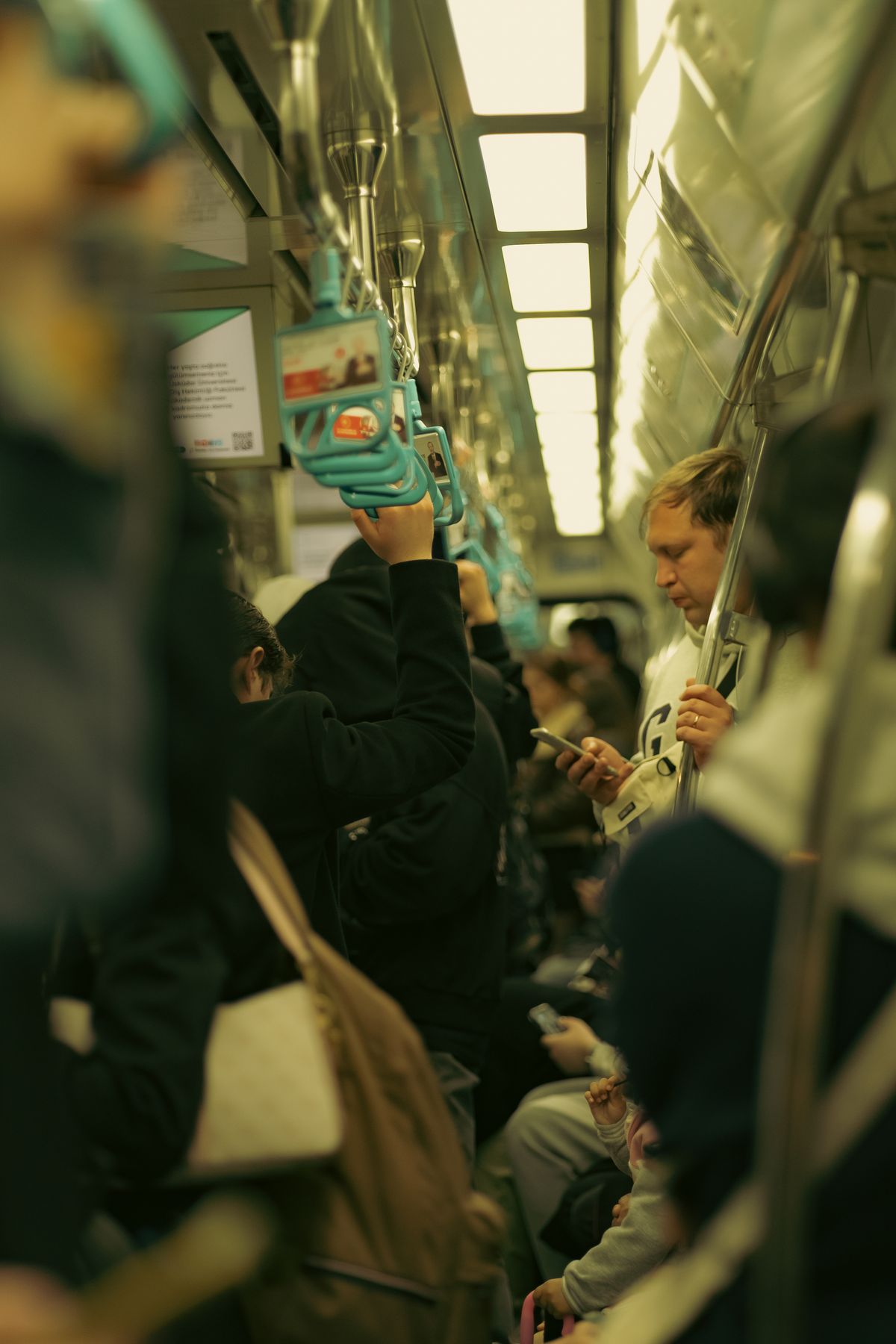
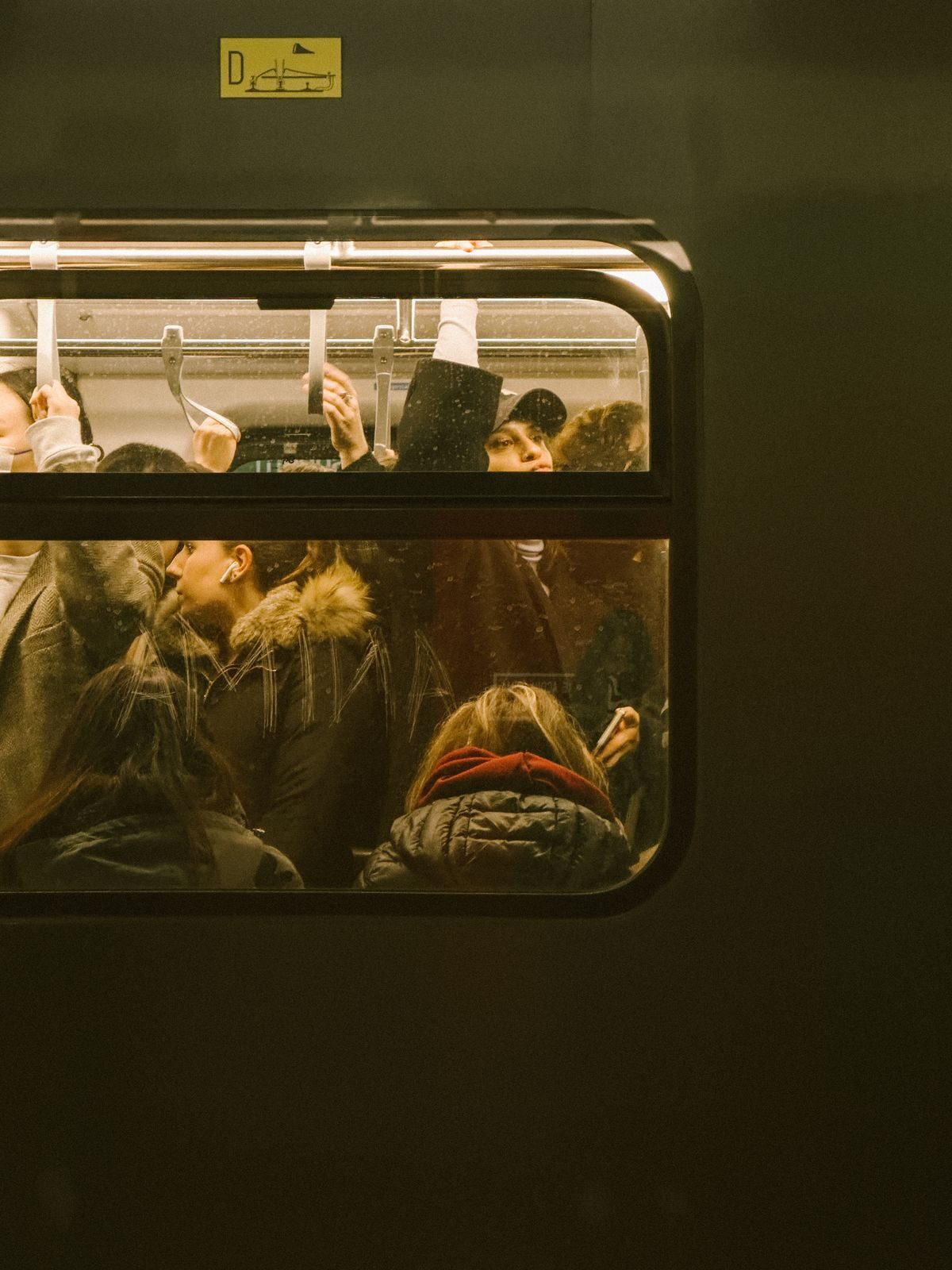
When the intimate zone is violated and it cannot be avoided — a lift, a train, an escalator at rush hour — people switch to a completely different set of rules. It is almost identical in every city in the world:
- Start no conversation with anyone, not even someone you know
- Always avoid eye contact
- Keep the face blank
- If you have a book or a phone, pretend to be absorbed in it
- In a crowd, keep body movement to an absolute minimum
- Keep your eyes fixed on the floor indicator
Important diagnostic warning
The blank face on a rush-hour train is not depression, not resentment, not coldness. It is compliance with a set of rules. Reading it as an emotional signal is the most typical context error in the whole of Zone 1 — and the one beginners make almost immediately.
Density and aggression
There is a memorable observation of a herd of deer living on an island: they died in large numbers despite abundant food, no predators and no disease. The cause was identified as density: the herd was too large, each animal’s territory shrank below threshold, the adrenal glands ran at excessive output for a prolonged period, and they died of their own defence system. The same mechanism has been recorded in rats and rabbits.
The consequence for humans is blunter than people like to admit: an angry crowd is usually angry about density more than about content. Dispersing a crowd is giving space back, and giving space back is cooling it down. The most densely populated neighbourhoods also tend to be those with the highest rates of violence, and this is part of the reason.
Zone 1 reading matrix
⚠️ Read only once the threshold has been crossed. Every row in the table below carries data only when the other person has left their own baseline — chapter 06. Inside the mute band, those same behaviours carry zero bits. And once the threshold has been crossed, they still give only sign, intensity, timing — not content (chapter 08).
| Observation | Leading hypothesis | Must be ruled out first |
|---|---|---|
| Keeps a greater distance than usual | Distrust, dislike, status difference, wariness | Rural origin; wide-zone culture; illness |
| Closing the distance on their own | Interest, wanting to be closer, confidence | Narrow-zone culture; hearing impairment; noisy environment |
| Leaning the torso back as you move in | The zone has been violated | Wanting to see the whole; long-sightedness |
| Building a barrier out of a glass, a bag, a phone | Discomfort — a strong signal | Just tidying things within reach |
| Offers a stiff straight arm when shaking hands | Keeping distance | Wide-zone origin; joint pain |
| Pulls you towards them when shaking hands | Feels safe only inside their own territory | Narrow-zone culture |
Intervention
| Goal | Action |
|---|---|
| Creating comfort | Keep your distance. Let the other person choose. Move closer only after you see an opening signal. |
| Closing the distance safely | Increase in small steps, always with a natural pretext, withdraw at once at any body-axis protection reaction. |
| Reducing tension | Step back 15–30 cm; move to a 45° angle instead of face to face; remove the barrier between you. |
| Asserting status | Enter the personal zone and stay there. But understand clearly that you are trading information quality for submission — a bargain that rarely pays. |
Chapter exercises
One. Over one week, record the distance five different people choose when talking to you. Estimating by hand-spans is fine. You will find the range wider than you expected.
Two. Stand in a lift lobby and watch: when the doors open and people step in, where do they choose to stand? Test the “midpoint of the widest gap” rule.
Three. Count the objects on your desk that could serve as a barrier. Move them away and see whether the next conversation goes differently.
Chapter summary
- The safe zone = the minimum distance that still leaves time to react. Not a number about politeness — a calculation about speed.
- Five bands: close intimate 0–15 cm · intimate 15–46 cm · personal 46 cm – 1.22 m · social 1.22–3.6 m · public over 3.6 m. The numbers are those of Western urban dwellers; elsewhere the ratios hold — the outer ring is always about three times the inner one.
- There are only two reasons to step into someone else’s fifteen-to-forty-six-centimetre zone: closeness, or an imminent attack. The recipient’s body cannot tell them apart at once, so it prepares for both.
- The physiological chain runs in a few seconds and NOBODY can switch it off: adrenaline, fast heart and raised blood pressure, blood withdrawing from the skin capillaries. Cold damp hands are the direct output of that chain — they rank highest for reliability in the scoring table in chapter 27.
- The safe zone is not a constant: eight factors stretch and shrink it. City ~46 cm · town ~1 m · remote areas up to 6 m. Southern Europe 20–30 cm · some East Asian countries ~25 cm · Northern Europe and Britain much wider.
- The step you may not skip: who am I to this person? Five roles, five expected distances that are completely different. Coming within sixty centimetres of a stranger is an intrusion; with a close friend it is ordinary.
- “The waltz”: a 25 cm zone meets a 46 cm zone, one party constantly advancing, the other constantly retreating, both drifting across the room. The advancer concludes “aloof”, the retreater concludes “pushy”. Both conclusions are wrong, and both rest on accurate observation.
- Territory does not stop at the skin. A book holds a seat for 77 minutes, a jacket for 2 hours. Inside a car the personal zone is magnified up to tenfold — road rage is a territorial problem, not a problem of temperament.
- On entering someone else’s home or office, ask one question before sitting down: “Which chair is yours?” Sitting in the wrong chair puts the host on the defensive from the first second, and you will spend the whole session measuring the very defence you caused.
- In an unfamiliar space, people choose the midpoint of the widest gap. The one recorded exception is the public toilet: about ninety per cent choose the cubicle at the end of the row.
- The blank face on a rush-hour train is compliance with a set of rules, not depression, resentment or coldness. Reading it as an emotional signal is the most typical context error of Zone 1.