14
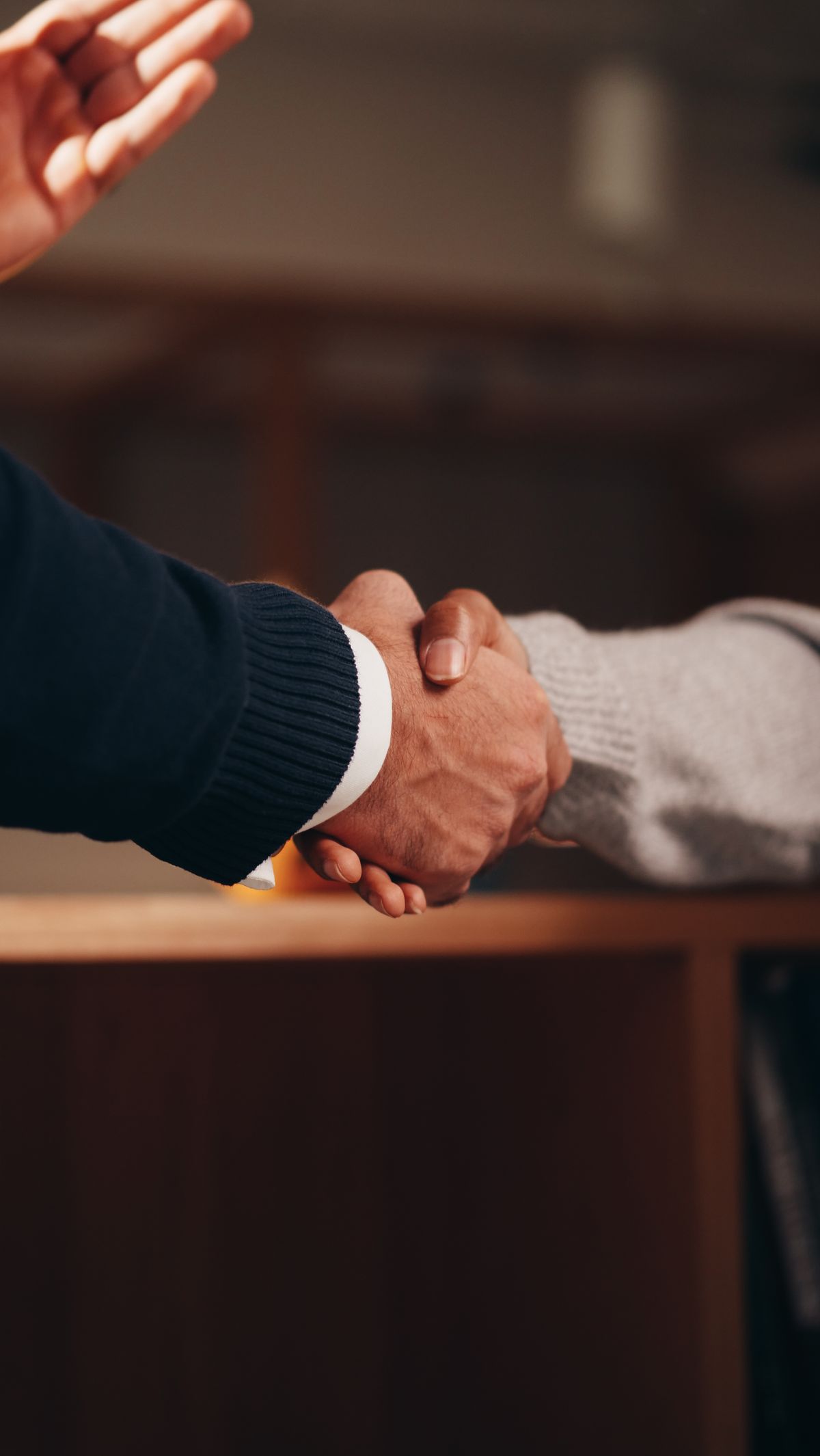
The handshake and the touch
The first two seconds of a meeting transmit more information than the twenty minutes that follow. This chapter takes those two seconds apart, and ends with a small experiment on the three-second elbow touch — the technique with the highest effect-to-effort ratio in the whole set.
Three attitudes transmitted below awareness
Every handshake transmits one of three messages, and the receiver decodes it before there is time to think.
A figure on how common it is: in a survey of three hundred and fifty successful senior managers, eighty-eight per cent of the men and thirty-one per cent of the women used the dominant position — and most of them were the ones who offered a hand first.
Another, subtler finding: extroverts tend to shake hands firmly; shy, easily agitated people shake hands weakly. And in particular — women with a firm handshake are usually open to new ideas, while in men no such correlation has been found.
The two elements of a good handshake
- Keep the palm vertical
Neither side dominates. If you feel your hand being turned downward, read the counter-moves below.
- Match the pressure
This is the part almost nobody does. The rule: if your natural pressure is seven out of ten and theirs is five, drop twenty per cent. If theirs is nine and yours is seven, add twenty per cent.
The figure matters for an anatomical reason: the average male hand is twice as strong as the average female hand, with a grip that can reach forty-five kilograms. A “normal” handshake for one person is a painful squeeze for another.
The eight worst handshakes
Norms by region — number of pumps
North America five to seven pumps · Britain three to five · Germany and France one to two, but the hand is held twice as long. The French shake hands on arrival and on leaving, which can come to half an hour a day. A German who gives you a “curt” handshake is not being cold — he is shaking hands exactly to his own norm.
Countering the dominant handshake
Three ways, in decreasing order of subtlety. The first is the one you should use.
- The top-hand move. Turn your right hand up to take theirs, then place your left hand on top of their right hand and straighten it to vertical. Discreet, but it only works when the distance allows.
- Last resort — grip their wrist first. Shocking, and remembered for a very long time. Use it only against deliberate, repeated intimidation, and understand that you have just turned a handshake into a statement.
The two-handed handshake — a hidden gauge of intimacy
The handshake in which one hand grips and the other is placed on the other person's arm is usually called “the politician's handshake”. What is worth reading here is the position of the left hand — it is a fairly accurate gauge of the degree of intimacy the person is claiming.
Why the two-handed handshake backfires with someone you have just met
About ninety per cent of people are born able to swing the right arm forward to defend themselves. The two-handed handshake restricts exactly that ability. With someone close it does no harm; with someone newly met it creates a feeling of being pinned that the receiver cannot name, and the result is that they become suspicious of your intentions — the exact opposite of what the person making the gesture intended.
The advantage of the left of the frame
A small but usable detail: the person standing on the left of the photograph finds it easier to put their hand on top, so they look like the one in control. Almost every famous political handshake photograph shows this.
If you end up on the right: put your arm out early, from a distance. That forces them to turn and face you, and the handshake returns to equality.

The three-second touch
This section describes a small experiment, and its result is uncomfortably large.
Cultural variation, and an inverse law
The rate at which a forgotten coin is returned when the elbow is touched, by country.
The inverse law
The less people touch each other, the more effective a touch is. Touches per hour in a café: in some Southern European cities about four; in London, none. And it is precisely where the figure is zero that a well-placed touch produces the largest effect.
The limits — and they are very narrow
What it needs in order to work
- Exactly the elbow — above or below is either less effective or counter-productive
- No more than three seconds
- Light, with a natural pretext, and without looking at the point of contact
When it backfires
- Over three seconds: the person touched will look down at your hand — a clear sign that you have gone past the limit
- A marked power gap
- A context with sensitive gender dynamics
- A culture that forbids touch between people who are not close
A few measured applications: a librarian who lightly touched the borrower's hand was rated as giving better service and was remembered by name more often. Waitresses who touched a diner's elbow or hand received about thirty-six per cent more in tips from male diners; waiters received about twenty-two per cent more regardless of the diner's sex.
And one figure worth remembering when you calibrate a baseline: women touch others of their own sex four times as often as men touch others of their own sex. If you are measuring touch frequency as an index of intimacy, your reference table has to differ by sex.
Chapter exercises
One. For one week, pay attention to the palm position of everyone who shakes your hand. Count what percentage is in the dominant position. The number will be higher than you think.
Two. Practise the left-foot step five times with someone you know before you use it for real. It needs feel, not force.
Three. Try the three-second elbow touch in a situation that allows it — giving way, handing something over, pointing out a direction. Count to three silently, then take your hand away. Watch the difference over the next thirty seconds.
Chapter summary
- Every handshake transmits one of three messages, and the receiver decodes it in under a second: hand on top, palm turned down is dominance · palm turned up is submission · both palms vertical is equality. They are not aware of having concluded anything, but they will behave according to that conclusion for the rest of the meeting.
- A survey of three hundred and fifty successful senior managers: eighty-eight per cent of the men and thirty-one per cent of the women used the dominant position — and most of them were the ones who offered a hand first.
- Matching the pressure is the part almost nobody does. Your natural pressure seven out of ten and theirs five, drop twenty per cent; theirs nine and yours seven, add twenty per cent. The reason is anatomical: the average male hand is twice as strong as the average female hand, with a grip that can reach forty-five kilograms.
- Nearly half of all “bad” handshakes have an innocent explanation — arthritis, culture, or a different personal-space norm. This is the context law at work.
- Pumps by region: North America five to seven · Britain three to five · Germany and France one to two, but the hand is held twice as long. A German who gives you a “curt” handshake is not being cold — he is shaking hands exactly to his own norm.
- The left-foot step. About ninety per cent of people step forward with the right foot when they shake hands. Stepping with the left brings your right foot across in front of them, into their personal space — and from there you turn the handshake vertical without any appreciable force.
- In the two-handed handshake, the position of the left hand is the degree of intimacy being claimed: wrist, elbow, upper arm, shoulder. If the claim is higher than the real relationship, the receiver feels uncomfortable without knowing why. With someone newly met it backfires in another way too: about ninety per cent of people are born able to swing the right arm forward to defend themselves, and the two-handed handshake restricts exactly that ability.
- A light three-second touch on the elbow raises the rate at which strangers return a forgotten coin from 23% to 68% — same question, same questioner. Almost three times, from one movement lasting three seconds.
- The inverse law: the less people touch each other, the more effective a touch is. Germany 85% · Australia 72% · Britain 70% · France 50% · Italy 22%. Touches per hour in a café: about four in some Southern European cities, none in London — and it is precisely where the figure is zero that a well-placed touch produces the largest effect.
- The limits are very narrow: exactly the elbow, no more than three seconds, light, with a natural pretext, without looking at the point of contact. Over three seconds and the person touched will look down at your hand — a clear sign that you have gone past the limit. Not to be used where there is a marked power gap.
- One figure for calibrating a baseline: women touch others of their own sex four times as often as men touch others of their own sex. If you are measuring touch frequency as an index of intimacy, your reference table has to differ by sex.